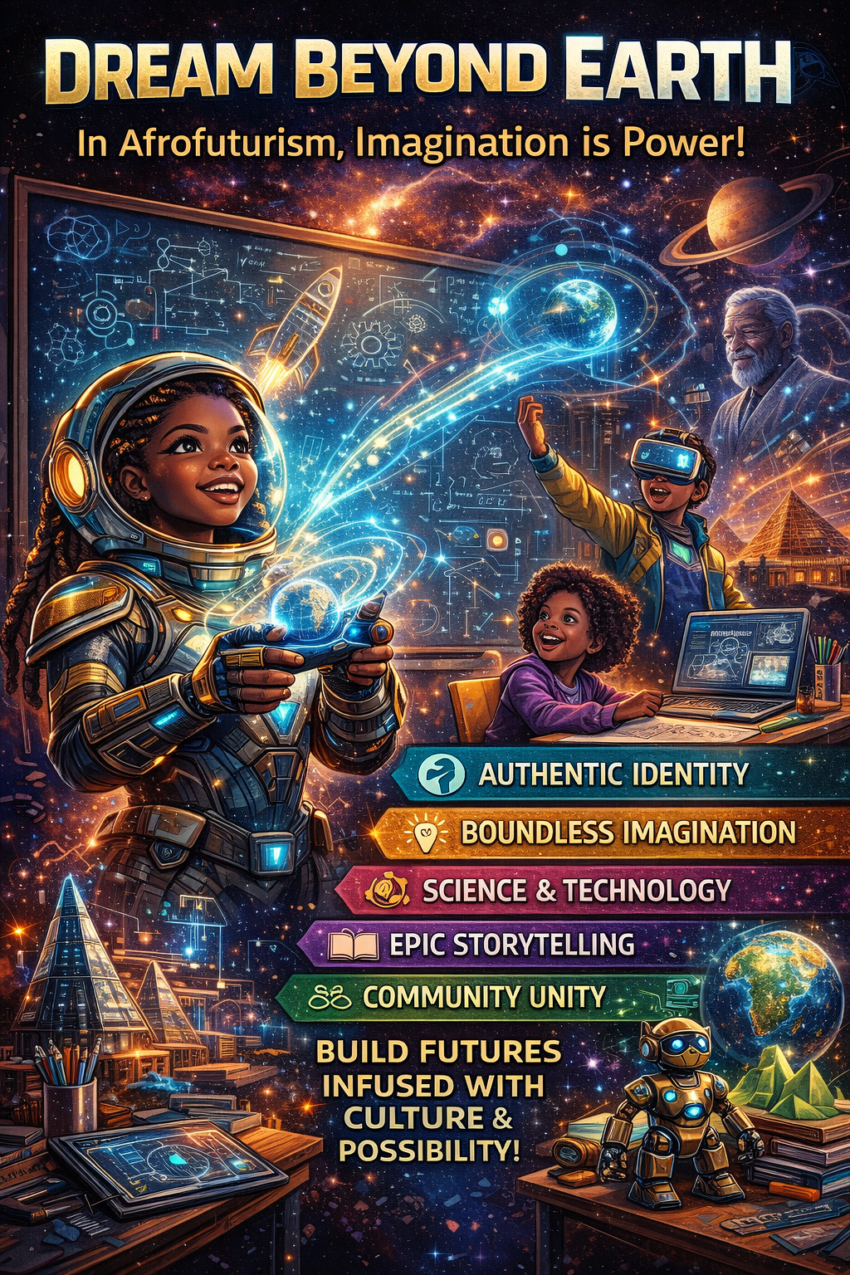
🌍 Imagination as a Tool — Not a Luxury
In schools across the world, children learn facts about the past — but rarely are they taught to imagine the future. Afrofuturism changes that. It invites students to dream, design, invent, and envision worlds where the next generation of Black youth are not just surviving — they are leading civilizations among the stars.
Afrofuturism in education isn’t just an artistic trend — it is a framework for liberation.
🧬 Why It Matters in Classrooms
Education systems have historically centered Western accomplishments. Black students often never see people who look like them depicted as scientists, astronauts, inventors, or technologists — which quietly shapes how they see themselves.
Afrofuturism steps in and says:
“Your lineage is genius. Your imagination is technology. And you belong in tomorrow.”
When a student draws their own futuristic city or writes a comic where a Black girl becomes the architect of a galaxy, something powerful happens — a silent ceiling shatters.
🚀 Classroom Experiments: Afrofuturism in Action
Schools piloting Afrofuturist programs are transforming learning environments:
🏫 Baltimore — The Wakanda Learning Lab
Students 3D-print solar-powered gadgets inspired by Ghanaian gold architecture.
📚 Atlanta — Comics as Curriculum
Middle schoolers write Afrofuturist graphic novels and animate them using tablets. English class becomes world-building.
🧪 Chicago — Science Powered by Culture
Physics lessons teach gravity through “anti-gravity boots” used in a fictional Nubian space colony.
🕹 Nairobi — Afro-VR Language Labs
Kids navigate a digital planet where inhabitants speak Kiswahili, Yoruba, and Luganda.
🎨 The Five Pillars of Afrofuturist Education
| Pillar | What It Teaches |
|---|---|
| Identity & Heritage | Students learn their culture is a cornerstone of innovation |
| Imagination & Creativity | Dreaming is treated as a skill — not a distraction |
| Technology & STEM | Coding, robotics, VR — but culturally centered |
| Storytelling & Narrative | Students write themselves as the heroes |
| Community & Legacy | Youth are taught to build futures for all, not just themselves |
👨🏽🏫 Teachers as Futurist Mentors
Afrofuturist teaching requires a shift in mindset — educators become guides, not just instructors. Instead of asking students to memorize facts, they ask:
- What does the world look like 200 years from now if your culture thrives?
- What problems would future Black societies solve — and how?
- What inventions would you create if no one told you “that’s impossible”?
Students respond — with inventions, comics, robots, poetry, spacecraft sketches, and ideas capable of reshaping neighborhoods.
🧑🏾🔬 Real-World Impact: Futures Start Early
Research shows that children form ideas about what careers “belong to them” by age 7. If they never see a Black scientist, they may silently decide science is “not for us.”
Afrofuturist classrooms break this mental programming.
When a Black child programs a robot, conducts a science experiment through ancestral storytelling, or steps into VR as an astronaut from the Kingdom of Kush — they experience a truth:
“The future needs me — and I am ready.”