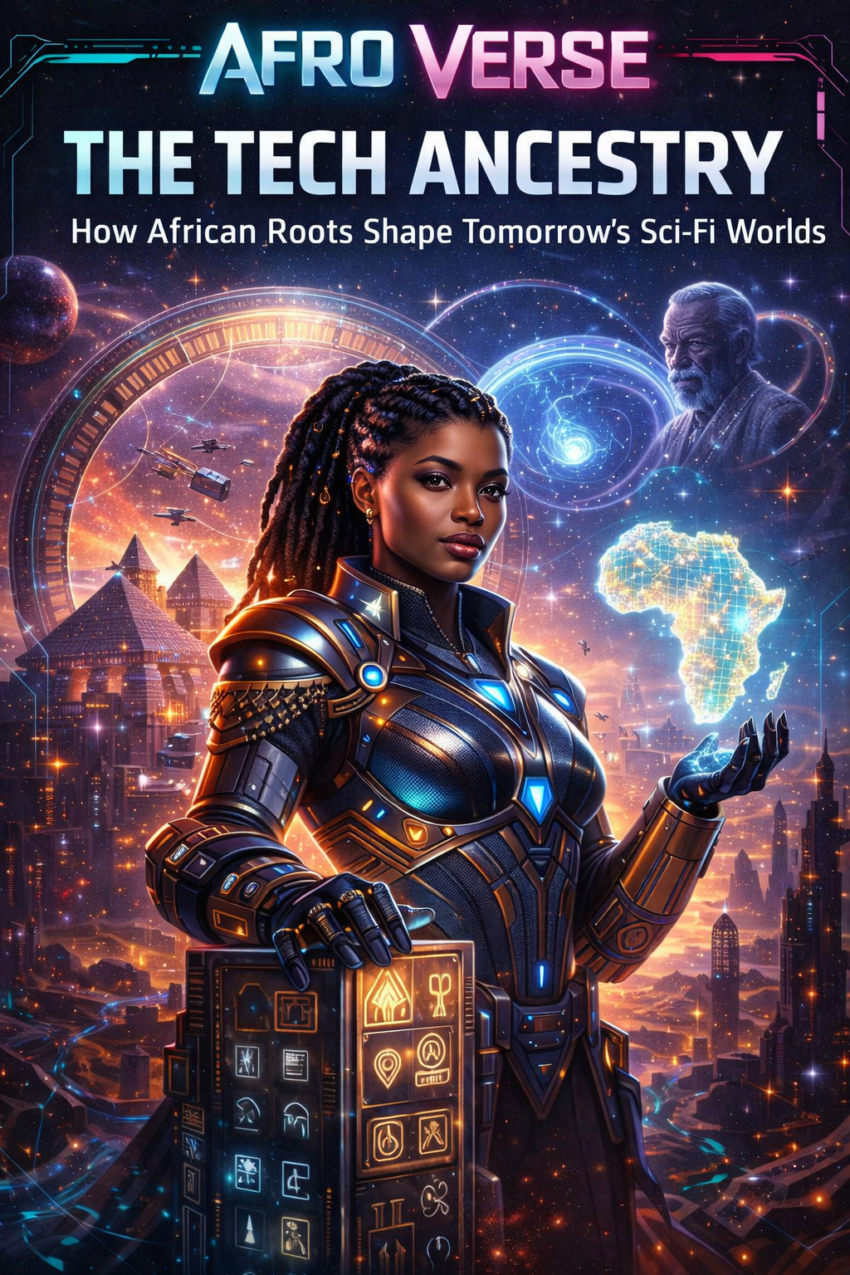
For centuries, Africa has been portrayed primarily in the context of history — kingdoms long gone, artifacts displayed behind museum glass, and narratives told by those who never experienced them firsthand. But within Afrofuturism and Black science fiction, something extraordinary is happening: the past is not a relic — it is a launchpad.
African roots are becoming blueprints for interstellar futures. And the creators driving this movement understand one thing clearly — the future of sci-fi cannot be complete without acknowledging the innovations, philosophies, and cosmologies that shaped ancient African civilizations.
Ancestors Were the First Engineers of the Impossible
Before there were skyscrapers and silicon chips, there were Nubian temples aligned perfectly with the stars, Dogon astronomy that mapped Sirius B before telescopes ever existed, and Akan metallurgy that produced tools so refined they influenced global weapon designs.
When Afrofuturist storytellers weave holographic pyramids, ancestral AI systems, or starships powered by spiritual energy, they are not inventing from thin air. They’re decoding history.
“The future we imagine is simply our past — restored, unbent, and given space to shine.”
Afrofuturism: The Fusion of Culture + Technology
In mainstream sci-fi, technology is often portrayed as sterile — characterized by chrome metal panels and artificial intelligence devoid of emotion. In African-inspired futurism, technology breathes. It carries rhythm. It remembers.
Creators imagine:
- Cities built like floating Timbuktu libraries
- AI systems coded in Adinkra symbols
- Ancestral memory banks storing generations of wisdom
- Spacecraft shaped like Maasai shields, glowing with kinetic solar energy
These worlds aren’t just aesthetic — they’re healing.
They answer the question:
What would our future look like if colonization never disrupted African innovation?
Designing the Future With Cultural Code
Today’s rising Black sci-fi authors, illustrators, and filmmakers are embedding heritage into futuristic creation:
🎨 Visual Artists craft suits of armor patterned with wax-print geometric circuits
🧬 Writers explore genetic memory as a literal tech system — ancestors whispering guidance
🕹️ Game Developers place African mythology inside intergalactic RPG quests
🎬 Filmmakers merge ancestral storytelling with VR and holographic cinema
Every pixel, every panel, every sentence is resistance.
Because every time a Black character stands on a spaceship and is not a sidekick, a galaxy shifts.
Why Tech Ancestry Matters
Representation is not the destination — ownership is.
In a world racing toward AI dominance, digital landscapes will shape thought, culture, and identity. If African voices are not architects in those spaces, they risk becoming ghosts in the machine.
Afrofuturism refuses that outcome.
It tells Black children:
“You were the first dreamers. You are the future builders. Your lineage is a technology.”
A Vision for Tomorrow
Imagine a future where:
- Schools teach coding through Yoruba proverbs
- Quantum computers operate using fractal math from Ethiopian monasteries
- Space colonies speak Swahili
- Ancestral spirits serve as navigation AI — guiding ships through wormholes
That isn’t fantasy — it’s a possibility.
The only question is whether we will tell these stories loudly enough that the world begins to believe them, too.
As Afro Verse Magazine continues to uplift Black sci-fi voices, we hold one mission:
To make space for every ancestor who never got to dream beyond Earth — by letting their descendants conquer the stars.