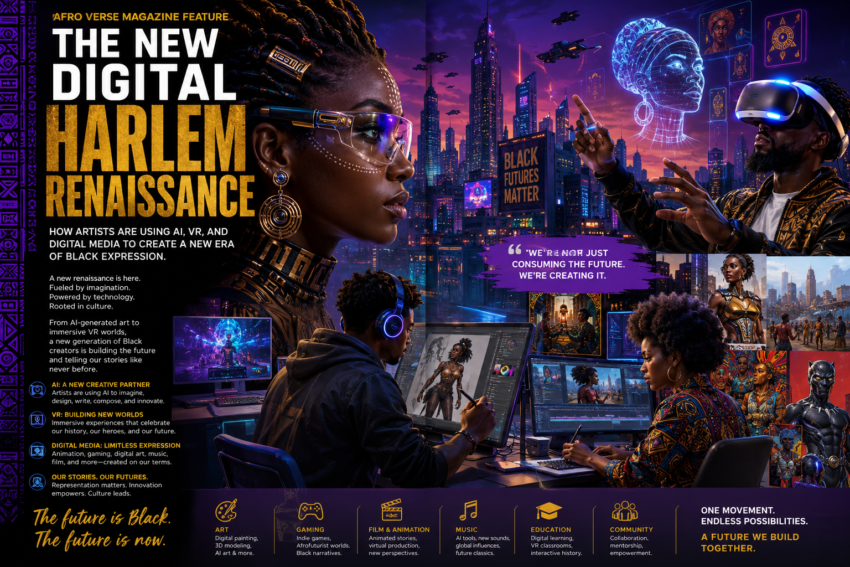
How Artists Are Using AI, VR, and Digital Media to Create a New Era of Black Expression
Nearly a century ago, the Harlem Renaissance transformed Black art, literature, music, and culture. Visionaries like Langston Hughes, Zora Neale Hurston, Aaron Douglas, Duke Ellington, and Augusta Savage redefined what Black creativity could be and inspired generations around the world.
Today, a new renaissance is unfolding—not in jazz clubs and publishing houses alone, but on digital canvases, virtual reality headsets, AI platforms, gaming engines, and social media. This movement is becoming known as the New Digital Harlem Renaissance, where technology serves as both a canvas and a catalyst for Black imagination.
The Canvas Has Changed
The artists of today are no longer limited to paintbrushes, cameras, or recording studios. They are creating with artificial intelligence, 3D modeling software, virtual reality, augmented reality, motion capture, and digital illustration.
With these tools, creators can design futuristic African cities, animate ancestral stories, develop immersive virtual museums, and build interactive experiences that celebrate Black identity from fresh perspectives.
Technology isn’t replacing creativity—it is expanding what’s possible.
AI as a Creative Partner
Artificial intelligence has become a powerful assistant for many artists.
Instead of beginning with a blank page, creators can use AI to generate concept art, brainstorm ideas, create mood boards, develop story outlines, and experiment with color palettes. Writers can explore new worlds, musicians can discover fresh sounds, and filmmakers can visualize scenes before production begins.
For many independent Black creators, AI is helping level the playing field by making professional-quality creative tools more accessible than ever before.
The key is understanding that AI doesn’t replace the artist. The vision, cultural knowledge, lived experience, and storytelling remain uniquely human.
Building New Worlds Through VR
Virtual Reality (VR) allows artists to create immersive experiences that audiences don’t just watch—they enter.
Imagine stepping into:
- A futuristic Wakanda-inspired metropolis powered by renewable energy.
- A virtual reconstruction of historic Black Wall Street.
- Ancient African kingdoms brought to life in full 3D.
- Interactive museums celebrating Black inventors, scientists, and artists.
- Space colonies designed through an Afrofuturist lens.
These experiences have the power to educate, inspire, and preserve culture for future generations.
Afrofuturism Meets Technology
Afrofuturism has always imagined futures where Black people thrive through innovation, science, and creativity.
Today’s digital tools are turning those visions into reality.
Artists are creating:
- AI-generated fashion collections inspired by African textiles.
- Digital comic books featuring original Black superheroes.
- Animated films rooted in African mythology.
- Interactive educational apps teaching Black history.
- Video games where African civilizations shape humanity’s future.
The result is a vibrant creative movement that blends heritage with innovation.
The Creator Economy Is Expanding
Digital platforms have made it possible for creators to build careers without relying solely on traditional gatekeepers.
Artists can now sell digital artwork, publish independent comics, launch online courses, stream creative processes, crowdfund projects, and connect directly with audiences around the world.
This growing creator economy is opening doors for storytellers, designers, educators, musicians, and entrepreneurs to transform their passions into sustainable businesses.
Why Representation Matters
Technology shapes how people imagine the future.
When Black voices are missing from those conversations, opportunities and perspectives are lost.
The New Digital Harlem Renaissance is ensuring that the future includes diverse stories, cultures, and visions of possibility. It challenges stereotypes and creates space for narratives where Black communities are innovators, explorers, scientists, architects, entrepreneurs, and leaders.
Representation isn’t simply about visibility—it helps shape the technologies, stories, and communities of tomorrow.
A Movement, Not a Moment
Just as the original Harlem Renaissance influenced generations of artists, this digital renaissance is inspiring young creators to dream bigger than ever before.
Across classrooms, community makerspaces, gaming studios, coffee shops, innovation labs, and home offices, Black creators are redefining what creativity looks like in the twenty-first century.
The movement belongs to everyone willing to imagine boldly, honor their heritage, and embrace new technologies as tools for storytelling and empowerment.
The New Digital Harlem Renaissance reminds us that while the tools have changed, the mission remains the same: to celebrate Black excellence, preserve culture, inspire innovation, and create a future where every generation can see itself reflected in the stories that shape the world.
Afro Verse Takeaway
The next Harlem Renaissance isn’t coming—it’s already here. It lives in every digital painting, AI-assisted design, virtual reality experience, independent game, animated film, and bold new idea created by Black visionaries around the globe.